Introduction
The behavior of search is evolving, as people use traditional search engines together with AI technologies to explore data, evaluate alternatives, and make decisions. SEO is an aid for businesses when it comes to visibility in the organic search results via the use of traditional search engines, while GEO is about improving the chances of having your brand mentioned in the answers provided by the AI system.
Quick answer
Whereas SEO is concerned about the visibility of a website in the organic search results, GEO is mainly about making it easier for users to find relevant information when responding via AI. Both SEO and GEO require reliable and relevant content, but there are differences in terms of how each is measured. SEO is not to be confused with GEO. Combining both SEO and GEO may benefit businesses.
What is SEO?
Search engine optimization (SEO) refers to the process of boosting a website's visibility within organic search results. SEO is about optimizing webpages to make them discoverable and understandable by search engines while also being helpful to the user.
SEO comprises a number of activities like technical SEO, keyword research, on-page SEO, content creation, internal linking, and building authority.
In the case of a company that offers accounting software, SEO can be carried out for searches like "accounting software for small business" or "invoicing automation."
This will be done with the aim of getting organic traffic that is relevant to the business and encouraging actions like downloading a demo or buying something.
What is generative engine optimization (GEO)?
GEO is about optimizing the way a brand, the content created, and the expertise of the brand are depicted through AI answers. Some examples of these types of experiences are AI search summaries, conversational search interfaces, and AI answer engines that compile data from multiple sources.
GEO means creating content that is pertinent, supported, and directly answers user inquiries. This could also mean having better topical coverage, providing credible evidence, having correct brand information, and making key website content available to the search.
For instance, a company that creates a comprehensive guide about choosing accounting software might want its expertise to be depicted by an AI when answering questions about choosing software for a small business.
The process of GEO doesn't ensure that the AI will mention a certain brand in its answer. Various AI engines have different ways of data retrieval and answering, so many things determine visibility.
Businesses exploring generative engine optimization services should look for strategies that improve content quality, brand discoverability, factual accuracy, and measurable visibility across relevant AI experiences.
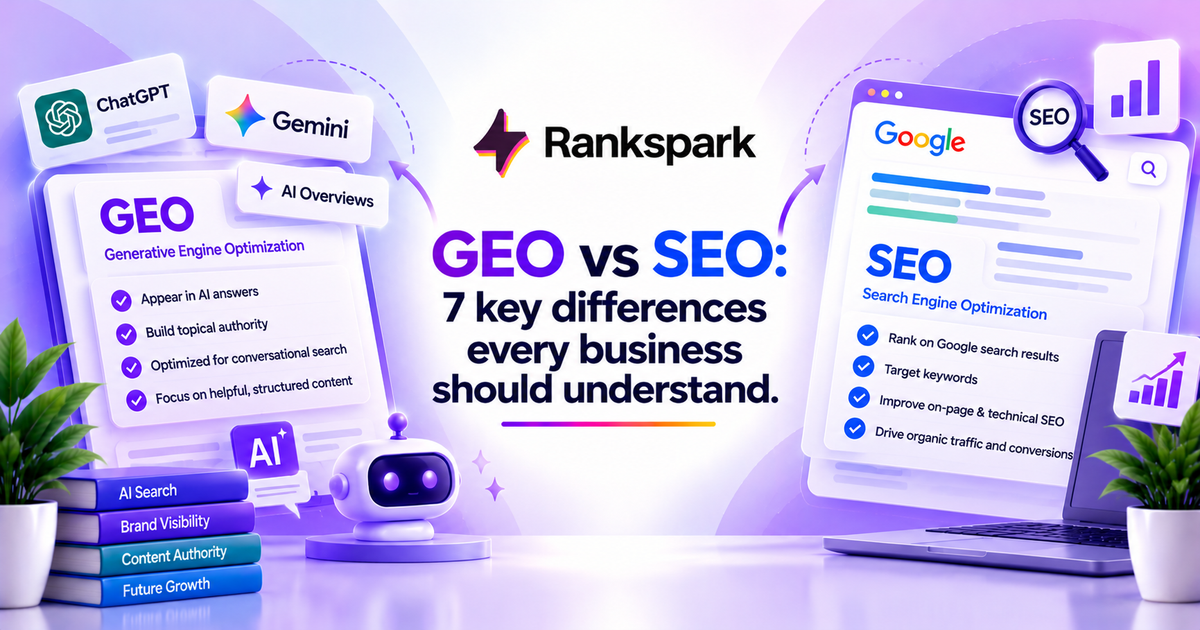
GEO vs. SEO: 7 key differences every business should understand
1. Primary visibility goal
The first difference between the two strategies lies in their goal of enhancing visibility.
While SEO is focused on improving the visibility of websites through organic searches, GEO is concerned with the improvement of the visibility of brand information in the AI-generated responses, summaries, and citations.
The outcome of successful implementation of SEO includes improvements in rankings and organic search traffic, while a successful GEO strategy includes correct mentions of brands, references, citations, and visibility in AI responses.
The two goals are similar since information from the websites optimized with SEO could be used by the AI systems. However, having high organic search rankings does not automatically translate into good AI visibility, and vice versa.
2. How users discover information
Conventional search results usually offer users links, which they then click and visit the site themselves to find the information.
Using AI, the search experience will directly summarize the required information in the form of an answer, which may include the source link or citation. The user will be given the recommendation or explanation at the very beginning without visiting many sites.
This alters the way companies need to go about the discovery process. The company not only needs SEO to ensure that its pages show up for valuable queries, but also GEO to determine if the information about the brand is appropriate for the AI answer.
The company needs to know the difference between the search methods, evaluate alternatives, and proceed towards buying decisions.
3. Content optimization approach
SEO content usually considers aspects such as search intent, keywords, page layout, topic, and the value of information presented.
Relevance and quality are the main aspects that are taken into account in GEO as well; however, ease of interpreting, verifying, and using information for answering becomes especially important for GEO. Some ways to achieve this include providing clear explanations, proper heading names, concise definitions, evidence, and consistent terminology.
Thus, the comparison of two business software applications should include an explanation of differences, the target audience for each product, and evidence for statements made.
Businesses investing in the best SEO company services should ensure that content optimization supports both traditional search visibility and the needs of people seeking direct answers through AI tools.
4. The role of authority and trust
Both SEO and GEO are reliant on quality information that is useful and credible, yet authority might have different representations in various search cases.
In SEO, links, content, website quality, and other SEO elements might be a part of organic search optimization. No one element will guarantee high rankings in any case.
For GEO, the consistency and credibility of the business information can make the expertise of the company helpful for an AI-generated article. Author information, credibility, personal experience, and business data can contribute to building credibility.
Businesses need to refrain from making unverified claims to attract AI citations since trust is earned only with credible information and expertise.
5. Technical requirements and content accessibility
Technical SEO aids search engines in finding, crawling, rendering, and indexing website content. If a website has issues such as broken links, indexing problems, a complicated structure, or inaccessible pages, it is unlikely to meet its objectives for search visibility.
The same applies to GEO. However, while the discoverability and comprehension of content are also required for GEO, there can be technical differences depending on which platforms are used. The various AI technologies use indexes, crawl websites, obtain licensed information, or use different sources of information.
Businesses need to build good foundations of technical SEO, have descriptive titles and headers, make sure that the information is available, and not hide any critical information behind any unnecessary obstacles.
Structured data can assist the search engine in interpreting some aspects of the page, but it does not mean that the information will be included in the answer provided via GEO algorithms.
6. Performance measurement
SEO and GEO need to have different methods of measurement since they do not share the same level of visibility.
SEO can be measured using organic impressions, clicks, rankings, organic conversions, quality leads, and even revenues in places where there is tracking.
GEO can be measured using brand mentions, citations, references, correctness of the answer, and visibility in questions on the chosen AI platforms. There is referral traffic and conversions from AI platforms that could help with more information.
The AI answers may differ depending on the user, question asked, location, and even the session. Therefore, just one manual test will not be sufficient.
Businesses working with top SEO service providers should agree on a measurement framework that distinguishes SEO outcomes from GEO indicators and connects both to business objectives.
7. Long-term strategy and business impact
SEO is an established, ongoing discipline that helps businesses build organic visibility through technical improvements, content, and authority development. Its impact can continue beyond the initial publication or optimization of a page, although rankings and traffic can change over time.
GEO addresses the additional challenge of how a business is represented in AI-generated discovery experiences. It can require monitoring how AI platforms describe a brand, checking whether sources are accurate, and improving content that answers important customer questions.
Neither approach guarantees traffic, leads, or revenue. Businesses should prioritize the channels and activities that help their target audiences find reliable information and make informed decisions.
A sustainable strategy integrates technical quality, useful content, credible expertise, and regular measurement rather than chasing short-term visibility tactics.
Why should USA businesses invest in both GEO and SEO?
For businesses targeting customers in the USA, search visibility can influence discovery at multiple stages of the buying journey. Potential customers may use Google to find providers, visit comparison pages, read reviews, and consult AI tools for summaries or recommendations.
A combined strategy helps businesses address these different behaviors. SEO supports traditional organic discovery, while GEO-informed content practices can improve the clarity, usefulness, and credibility of information that AI systems may reference.
For example, a B2B company targeting US decision-makers can develop detailed service pages, publish research-backed industry guides, answer common buyer questions, and maintain consistent business information across relevant platforms.
Businesses should also tailor content to their target market, including relevant terminology, service areas, industry requirements, and customer concerns. These efforts can strengthen search visibility without assuming that every AI platform uses the same sources or selection criteria.
How can businesses combine GEO and SEO effectively?
An integrated strategy begins with a strong SEO foundation and extends it to relevant AI discovery experiences.
Start with search intent and customer questions
Identify the problems your audience is trying to solve, the comparisons they make, and the information they need before contacting a provider. Use keyword research, customer feedback, sales conversations, and search performance data to guide priorities.
Improve existing content before publishing more
Review important service pages, product pages, and articles for accuracy, clarity, completeness, and relevance. Add missing explanations, improve headings, update outdated information, and support important claims with reliable sources where appropriate.
Strengthen topical coverage and expertise
Create useful content that addresses related questions across the customer journey. Demonstrate experience through original insights, detailed examples, expert commentary, and transparent authorship where relevant.
Maintain technical SEO foundations
Check crawlability, indexability, internal links, page structure, mobile usability, and site performance. Make sure important content can be accessed by the search systems you want to reach, subject to each platform's requirements.
Measure each channel separately
Monitor organic search performance and AI visibility indicators independently. Compare changes over time and assess whether improved visibility contributes to qualified traffic, enquiries, or sales.
Businesses considering managed seo services should ask how technical SEO, content improvements, AI-search visibility, and reporting will work together under a clear strategy.
What role does AI play in modern SEO and GEO?
AI can support research, content analysis, topic clustering, content gap identification, and performance monitoring. It can also help teams review how well existing content answers common questions and identify opportunities to make information clearer.
However, using AI to create large volumes of generic content is not a reliable substitute for expertise, original insight, or quality control. Content should be reviewed for factual accuracy, relevance, originality, and usefulness before publication.
For businesses exploring AI-powered SEO services, evaluate how AI is being used in the actual workflow. The provider should explain where automation adds value, how human review is maintained, and how the strategy is measured.
AI should support informed decision-making rather than replace a clear understanding of the audience, business goals, and search environment.
What are common GEO and SEO mistakes to avoid?
Businesses can weaken both strategies by focusing on visibility tactics instead of the quality and usefulness of their information.
- Treating GEO as a replacement for SEO: Maintain a sound organic search foundation while adapting to AI-driven discovery.
- Publishing generic AI-generated content: Prioritize original insights, reliable facts, and meaningful value for readers.
- Overusing keywords: Write naturally and address the subject comprehensively rather than repeating phrases unnaturally.
- Assuming structured data guarantees AI citations: Use structured data accurately for supported purposes without expecting guaranteed visibility.
- Tracking mentions without business context: Evaluate whether visibility reaches the right audience and contributes to meaningful outcomes.
- Believing one AI test proves success: Check multiple relevant queries and repeat observations over time to account for variation.
Conclusion
Both GEO and SEO have the same objective – assisting people in finding relevant and reliable information about a company. SEO is concerned with achieving good organic results through search engines, while GEO examines how the content and the expertise of the brand are displayed in the AI answers. Even though the techniques and metrics of these two approaches differ, the most effective way of using them is as complementary elements of an overall search strategy. Companies need to create a solid technical foundation, create authoritative content, and show expertise.
Contact RankSpark to improve your visibility across search engines and AI platforms.
Frequently asked questions
1. What is the main difference between GEO and SEO?
SEO improves visibility in traditional organic search results, while GEO focuses on increasing the chances of being represented or cited in AI-generated answers.
2. Is GEO replacing SEO in 2026?
No, GEO complements SEO because traditional search remains important while AI-driven discovery creates additional visibility opportunities.
3. Does SEO help with GEO?
Yes, strong technical foundations, relevant content, and credible information can support both SEO and AI-search visibility, although rankings do not guarantee AI citations.
4. How do you measure GEO performance?
Businesses can monitor relevant AI mentions, citations, linked sources, answer accuracy, referral traffic, and conversions where measurable.
5. Does structured data improve GEO visibility?
Structured data can help supported systems interpret page information, but it does not guarantee that AI platforms will cite or recommend a business.
6. Should small businesses invest in GEO?
Small businesses can start by improving their SEO foundations, answering customer questions clearly, maintaining accurate business information, and monitoring relevant AI-search visibility.
7. Can one strategy cover both GEO and SEO?
Yes, an integrated strategy can combine technical SEO, useful content, credible expertise, and separate performance tracking for organic search and AI visibility.