


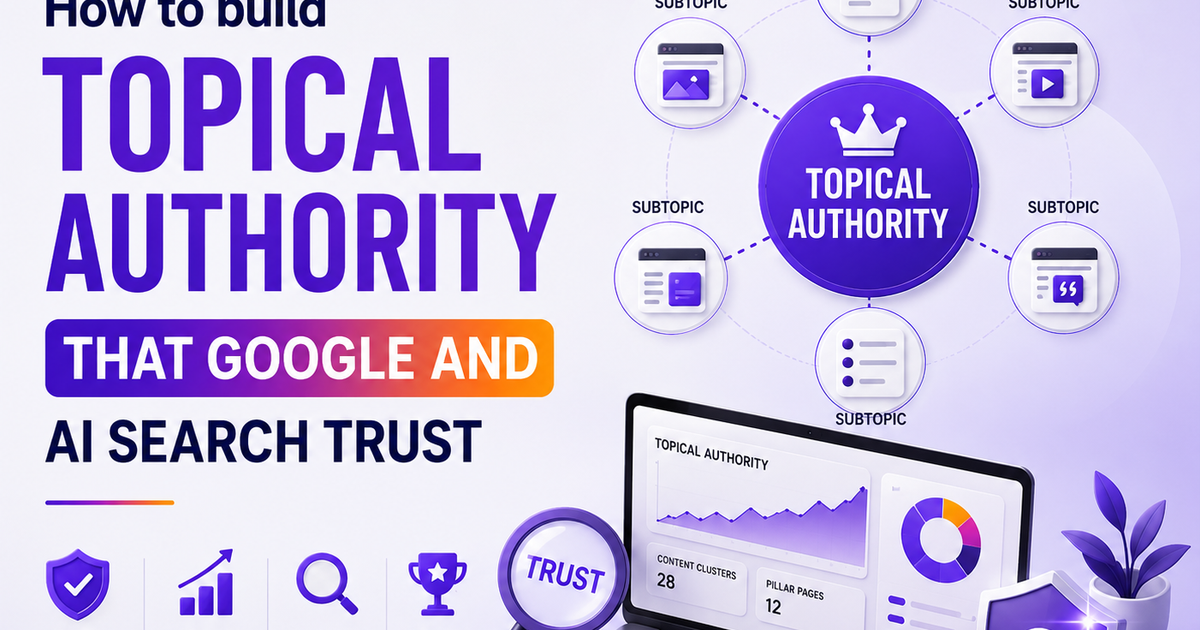
Search engines are evolving rapidly, and ranking for individual keywords is no longer enough. Today, Google and AI-powered search platforms prioritize websites that demonstrate deep expertise across an entire subject area. This blog explains how to build topical authority, why it matters for long-term organic growth, and the practical steps businesses can take to become trusted sources in both traditional and AI-driven search results.
Quick Answer
Topical authority is built by creating comprehensive, interconnected content that thoroughly covers a subject from multiple angles. Google and AI search systems evaluate how well your website demonstrates expertise, relevance, and depth across a topic. Businesses can strengthen topical authority through content clusters, strategic internal linking, expert insights, regular updates, and a consistent publishing strategy that addresses user intent at every stage of the buyer journey.
What is topical authority?
Topical authority is the level of expertise and trust a website demonstrates within a specific subject area. Instead of evaluating a single page in isolation, search engines assess how effectively a website covers related topics, answers user questions, and connects information through a structured content ecosystem.
For example, a website focused on SEO should not only publish articles about rankings but also cover technical SEO, content strategy, local SEO, link building, AI search trends, analytics, user experience, and emerging search technologies. When a site consistently provides valuable information across related topics, search engines recognize it as an authoritative source.
Google’s algorithms increasingly reward websites that demonstrate expertise, experience, authority, and trustworthiness (E-E-A-T). AI-powered search engines follow similar principles by citing and recommending sources with comprehensive topical coverage.
Why is topical authority important?
Topical authority delivers significant benefits for businesses seeking sustainable organic growth.
First, it improves search visibility across hundreds or even thousands of related search queries. Instead of relying on a few keywords, authoritative websites rank for entire topic ecosystems.
Second, it strengthens user trust. Visitors are more likely to engage with brands that provide complete answers rather than isolated pieces of information.
Third, topical authority increases the likelihood of being referenced in AI-generated search results. As AI search platforms continue to expand, trusted sources gain greater exposure and brand visibility.
From a business perspective, topical authority can reduce customer acquisition costs, increase qualified traffic, improve conversion rates, and support long-term digital growth strategies.
Organizations investing in best-rated SEO services often prioritize topical authority because it creates lasting competitive advantages that are difficult for competitors to replicate quickly.
How topical authority works in Google and AI search across the USA
Google and AI search systems use multiple signals to determine whether a website is authoritative on a topic.
The process typically begins with content relevance. Search engines analyze how comprehensively a website covers related subjects and subtopics.
Next, semantic relationships are evaluated. Modern algorithms understand connections between concepts, entities, and user intent. A strong content network demonstrates expertise beyond individual keywords.
Internal linking also plays a critical role. Well-structured content clusters help search engines understand relationships between pages and identify pillar content.
User engagement signals further reinforce authority. When visitors spend time reading, exploring related content, and returning to a website, search engines interpret those behaviors as positive quality indicators.
For businesses targeting competitive markets in the USA, combining content depth with effective AI SEO optimization helps improve visibility in both traditional search results and emerging AI-powered search experiences.
What should businesses know about topical authority?
Building topical authority requires a strategic and long-term approach.
The first best practice is identifying a clear topic focus. Businesses should define their core expertise areas and build content around those themes.
Creating pillar pages is another essential strategy. Pillar content serves as a comprehensive resource covering broad topics, while supporting articles address specific subtopics in greater detail.
Consistency matters significantly. Publishing occasional content is rarely enough to establish authority. Search engines favor websites that continuously expand and update their knowledge base.
Businesses should also focus on user intent rather than keyword volume alone. Understanding what users want to learn, compare, or solve helps create more valuable content.
Working with great SEO companies can accelerate this process by developing topic maps, content clusters, and strategic publishing frameworks aligned with search engine expectations.
Industry experts also recommend regularly refreshing existing content to maintain relevance and accuracy as search trends evolve.
Common challenges or mistakes
Many businesses attempt to build authority but make mistakes that limit results.
One common issue is publishing unrelated content across too many topics. This dilutes expertise signals and makes it difficult for search engines to identify the website's primary focus.
Another mistake is creating large volumes of shallow content. Quantity alone does not establish authority. Search engines prioritize depth, relevance, and usefulness.
Poor internal linking is another frequent problem. Without clear connections between pages, search engines may struggle to understand topic relationships.
Many organizations also overlook content updates. Outdated information can reduce credibility and negatively impact rankings over time.
Keyword stuffing remains a misconception as well. Modern algorithms reward natural language and topic coverage rather than excessive keyword repetition.
Finally, businesses often focus only on rankings while ignoring user experience. Authority is strengthened when content genuinely helps users solve problems and make informed decisions.
When should you consider building topical authority in the USA?
Topical authority should be a priority whenever a business depends on organic search visibility for growth.
It is particularly valuable for SaaS companies, professional service providers, healthcare organizations, law firms, financial institutions, eCommerce brands, B2B companies, and local businesses operating in competitive markets.
Businesses launching new websites can benefit from building authority early to establish credibility faster. Established companies can use topical authority strategies to expand market share and improve visibility for high-value search terms.
Organizations investing in Google search optimization should also prioritize topical authority because it aligns with how modern search algorithms evaluate expertise and trust.
As AI-powered search platforms become more influential across the USA, topical authority will continue to play a central role in determining which brands receive visibility and recommendations.
Conclusion
Building topical authority is no longer optional for businesses that want sustainable organic growth. Google and AI search platforms increasingly reward websites that demonstrate expertise through comprehensive content, strategic internal linking, and consistent topic coverage. By focusing on user intent, creating content clusters, maintaining content quality, and regularly expanding your knowledge base, you can strengthen your authority within your industry. Over time, this approach improves rankings, increases trust, drives qualified traffic, and positions your brand as a reliable source that both search engines and AI systems confidently recommend.
Contact RankSpark today to build topical authority that improves your Google rankings and AI search visibility.
Frequently asked questions
1. How long does it take to build topical authority?
Most businesses begin seeing measurable improvements within three to six months, although highly competitive industries may require a longer investment period.
2. Does topical authority help with AI search results?
Yes. AI-powered search systems often favor sources that demonstrate expertise, comprehensive coverage, and strong trust signals within a specific topic area.
3. What is the difference between topical authority and domain authority?
Domain authority generally measures the overall strength of a website, while topical authority focuses on expertise and relevance within a particular subject.
4. How many articles are needed to establish topical authority?
There is no fixed number. Success depends on content quality, topic coverage, internal linking structure, and how effectively user intent is addressed.
5. Can small businesses build topical authority?
Absolutely. Small businesses can often build authority faster by focusing on niche topics and creating highly specialized content that larger competitors may overlook.
6. Why is internal linking important for topical authority?
Internal links help search engines understand relationships between pages, distribute authority throughout the website, and improve user navigation across related topics.