

The way people search for information is changing rapidly. Traditional search engines are now being joined by AI-powered answer engines and generative search platforms. As a result, businesses must understand the differences between SEO, GEO, and AEO to remain visible online. This blog explains how each strategy works, why they matter, and which approach businesses should prioritize to maximize visibility across search engines and AI-driven platforms.
Quick Answer
SEO, GEO, and AEO all serve different purposes, but businesses should not choose only one. SEO helps improve visibility in traditional search engines, AEO focuses on appearing in direct answers and featured results, while GEO is designed to increase visibility within AI-generated responses. The most effective strategy combines all three approaches to ensure your brand remains discoverable wherever users search for information.
What are SEO, GEO, and AEO?
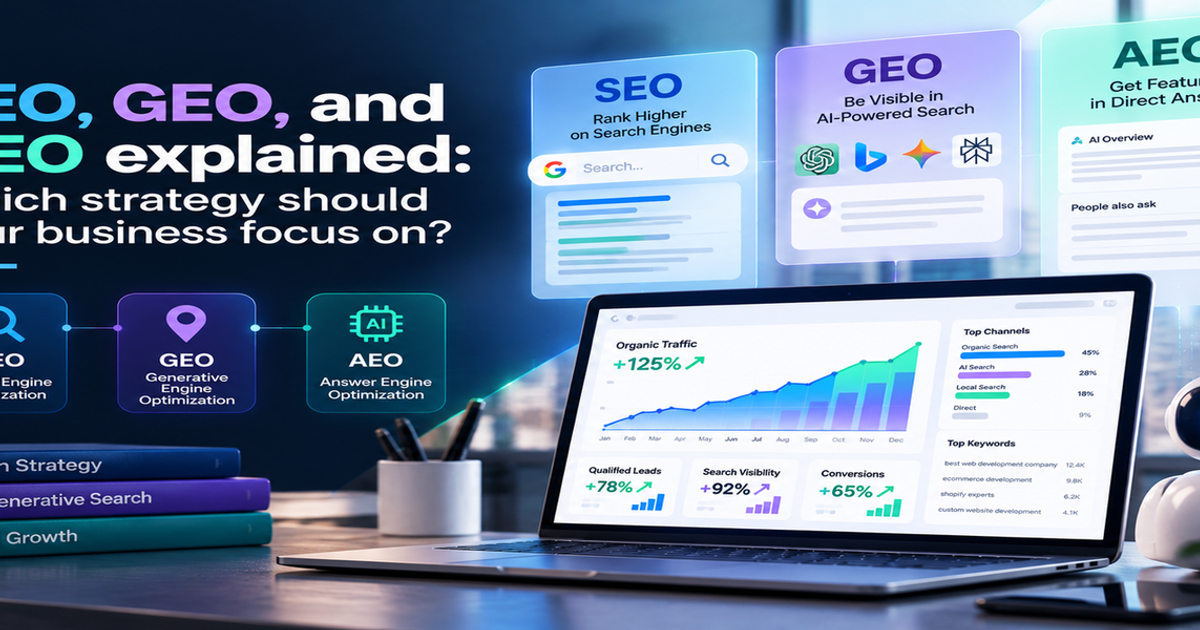
SEO (Search Engine Optimization) is the practice of improving a website's visibility in traditional search engine results. It focuses on rankings, traffic, content optimization, technical SEO, and user experience.
AEO (Answer Engine Optimization) focuses on helping content appear in direct answers, featured snippets, voice search results, and answer-based search experiences. The goal is to provide concise and accurate information that search engines can easily surface.
GEO (Generative Engine Optimization) is the process of optimizing content and digital assets for AI-powered search platforms. GEO helps businesses increase the likelihood of being cited, referenced, or recommended within AI-generated responses.
While these strategies overlap in some areas, they are designed to support different search experiences and user behaviors.
Why are SEO, GEO, and AEO important?
Consumer search behavior is evolving beyond traditional keyword searches.
Users now ask complete questions through AI assistants, voice search devices, and conversational search platforms. This shift means businesses must optimize for multiple discovery channels rather than relying solely on traditional rankings.
SEO continues to drive organic website traffic and remains essential for long-term visibility.
AEO helps brands appear in answer-focused search experiences where users expect immediate information.
GEO ensures brands remain visible within AI-generated responses and recommendations.
Many businesses investing in best SEO company services are expanding their strategies to include AEO and GEO as AI-powered search adoption continues to grow.
The businesses that adapt early are more likely to maintain visibility as search technology evolves.
How do SEO, GEO, and AEO work?
SEO works by improving website relevance, authority, technical performance, and content quality to rank higher in search engine results pages.
AEO focuses on structuring content in a way that makes it easy for search engines to extract answers. This includes FAQs, structured data, concise explanations, and clear formatting.
GEO focuses on creating authoritative, trustworthy, and comprehensive content that AI systems can confidently reference when generating responses.
Although each strategy has different objectives, they share common foundations such as high-quality content, topical authority, strong user experience, and credibility.
Businesses utilizing AI SEO services often integrate all three approaches to create a unified search visibility strategy that performs across multiple platforms.
Which strategy should businesses focus on in the USA?
For most businesses in the USA, SEO should remain the foundation of digital visibility.
Traditional search engines continue to drive significant traffic, leads, and revenue. However, relying solely on SEO may limit future growth opportunities.
AEO becomes increasingly important for businesses targeting informational searches, voice search users, and featured snippet opportunities.
GEO should be prioritized by organizations seeking visibility within AI-powered search platforms such as ChatGPT, Gemini, and Google AI Overviews.
The ideal approach is not choosing one strategy over another but creating a framework where SEO, GEO, and AEO work together to support overall visibility.
Businesses that embrace this integrated approach are better prepared for the future of search.
What should businesses know about GEO and AI search?
GEO is becoming a critical component of modern digital marketing strategies.
Unlike traditional SEO, GEO focuses on helping AI systems understand, trust, and reference your content.
This requires businesses to build strong topical authority, publish expert-driven content, maintain factual accuracy, and strengthen entity recognition.
Companies investing in generative engine optimization services are increasingly focused on improving citation opportunities, AI visibility, and brand mentions across emerging search platforms.
As AI search adoption continues to increase, GEO will play a larger role in determining which brands gain visibility during the research and decision-making process.
Businesses that establish authority now will be better positioned as AI-driven search becomes more mainstream.
Common challenges or mistakes
One common mistake is treating SEO, GEO, and AEO as completely separate strategies.
In reality, these approaches are highly interconnected and often support one another.
Another issue is focusing only on rankings while ignoring user intent and content quality.
Many businesses also fail to adapt content for answer-based and conversational search experiences, limiting their visibility opportunities.
Publishing generic content without demonstrating expertise can reduce effectiveness across all three strategies.
Organizations that ignore AI-driven search trends may struggle to maintain visibility as user behavior continues to evolve.
Working with providers that offer AI-powered SEO services can help businesses develop a more future-ready search strategy.
When should you consider SEO, GEO, and AEO in the USA?
Businesses should consider implementing SEO, GEO, and AEO as soon as they begin investing in digital visibility.
Organizations operating in competitive USA markets can benefit significantly from a diversified search strategy.
Industries such as SaaS, healthcare, legal services, finance, education, technology, professional services, and eCommerce are already seeing the impact of AI-powered search adoption.
Businesses seeking long-term growth should focus on building visibility across traditional search engines, answer engines, and generative AI platforms simultaneously.
This approach reduces dependency on a single traffic source and creates stronger opportunities for sustained digital growth.
Conclusion
SEO, GEO, and AEO each play an important role in modern search visibility. SEO remains essential for traditional rankings and organic traffic, while AEO helps businesses appear in direct answers and featured results. GEO expands visibility into AI-generated search experiences where users increasingly seek information and recommendations. Rather than choosing one strategy, businesses should adopt a balanced approach that combines all three. By doing so, organizations can strengthen their visibility, authority, and competitiveness across the rapidly evolving search landscape.
Contact RankSpark today and build a strategy that improves visibility across search engines and AI platforms.
Frequently Asked Questions
1. What is the difference between SEO, GEO, and AEO?
SEO focuses on traditional search rankings, AEO targets answer-based search experiences, and GEO helps businesses gain visibility within AI-generated responses.
2. Is GEO replacing SEO?
No. GEO complements SEO rather than replacing it. Businesses should use both strategies to maximize visibility across different search environments.
3. Why is AEO important?
AEO helps businesses appear in featured snippets, voice search results, and answer-based search experiences where users seek immediate information.
4. Which strategy should businesses prioritize first?
Most businesses should establish a strong SEO foundation while gradually incorporating AEO and GEO into their overall digital strategy.
5. How does GEO improve AI search visibility?
GEO helps AI systems identify authoritative, trustworthy, and comprehensive content that can be referenced in generated responses.
6. Can small businesses benefit from SEO, GEO, and AEO?
Yes. Small businesses can improve visibility, authority, and lead generation by implementing a combined strategy that addresses traditional and AI-driven search opportunities.