Introduction
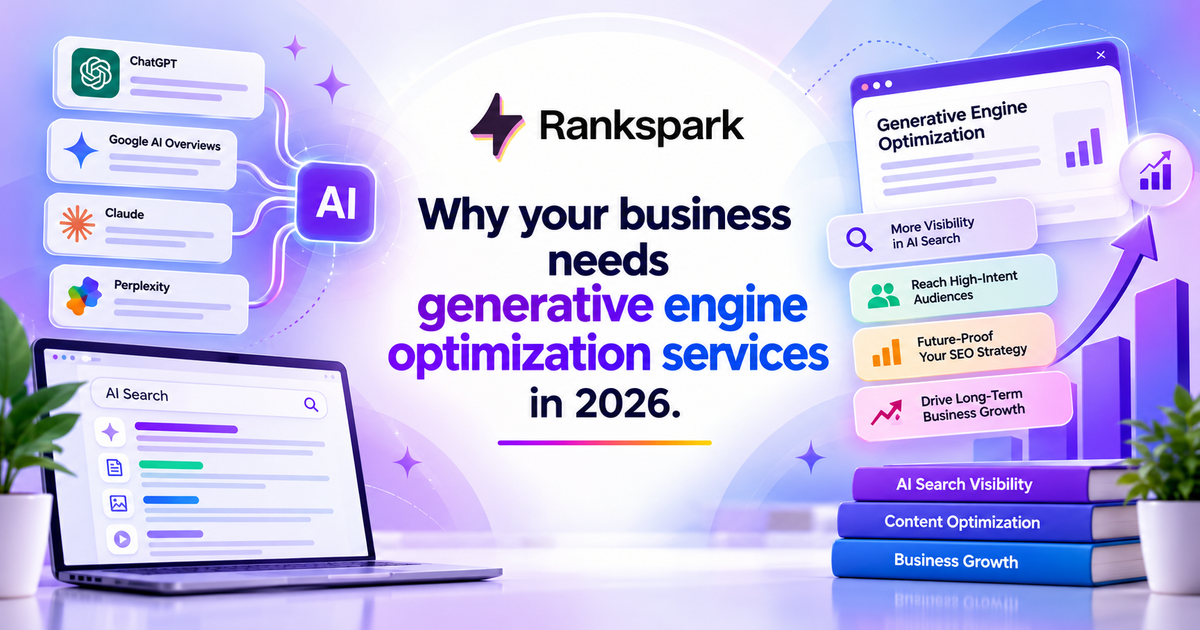
Search is changing rapidly in 2026. People are no longer relying only on traditional search results to discover businesses, products, and services. AI-generated answers from platforms such as Google AI Overviews, ChatGPT, Gemini, and Perplexity are becoming an important part of the discovery journey. This shift means businesses need strategies that help their content become visible, understandable, and reference-worthy in AI-generated results.
Quick answer
Generative engine optimization (GEO) helps businesses improve their visibility in AI-generated search experiences. Unlike traditional SEO, which primarily focuses on rankings in search engine results pages, GEO focuses on making a brand's information easier for AI systems to understand, retrieve, summarize, and cite. In 2026, combining SEO with GEO can help businesses reach customers across both traditional and AI-powered discovery channels.
What is generative engine optimization?
Generative engine optimization is the practice of optimizing a website and its content so that AI-powered search and answer engines can better understand and potentially reference the information when generating responses.
Traditional SEO focuses heavily on factors such as:
- Keyword relevance
- Search rankings
- Organic traffic
- Backlinks
- Technical website performance
- Search intent
GEO adds another layer by considering how AI systems interpret information and construct answers. Content needs to provide clear context, demonstrate expertise, answer specific questions, and make important facts easy for automated systems to identify.
This does not mean abandoning traditional SEO. Instead, businesses can use GEO alongside established SEO practices to improve their overall search visibility.
Why is generative engine optimization important for businesses in 2026?
AI search is changing how users find and evaluate information. A potential customer may ask an AI platform for recommendations, compare providers, research a service, or ask for an explanation before ever clicking through a traditional search result.
Businesses that optimize only for conventional rankings may therefore miss opportunities within these emerging search experiences.
AI search is becoming part of the customer journey
Consumers increasingly use conversational search to research questions and evaluate options. AI-generated answers can summarize information from multiple sources and provide users with a more direct research experience.
For businesses, this creates a new visibility opportunity: becoming a source that AI systems can understand and use when answering relevant queries.
Search visibility is becoming more than rankings
A business can rank well for a keyword and still have limited visibility in an AI-generated answer. GEO addresses this additional layer by focusing on information clarity, topical relevance, authority, and content structure.
Customers want direct answers
AI search is particularly useful for conversational and complex queries. Instead of searching for a short keyword, users can ask detailed questions about pricing, features, comparisons, services, or buying decisions.
Content designed around these questions can help businesses cover more of the information customers need throughout the decision-making process.
How does generative engine optimization work?
GEO involves improving the information architecture, content quality, authority signals, and accessibility of a website so AI systems can more effectively interpret its information.
A practical GEO process can include:
- 1.Understanding conversational search intent: Identify the questions, comparisons, problems, and informational needs customers may ask AI platforms.
- 2.Building topical depth: Create comprehensive content around important subjects instead of publishing isolated pages targeting individual keywords.
- 3.Improving content structure: Use descriptive headings, concise answers, definitions, lists, examples, and supporting information that make content easier to interpret.
- 4.Strengthening credibility: Demonstrate relevant experience, expertise, authoritative sources, original insights, and transparent business information.
- 5.Optimizing entities and context: Clearly explain what the business offers, who it serves, where it operates, and how its products or services differ.
- 6.Supporting traditional SEO: Maintain strong technical SEO, internal linking, crawlability, page experience, and search-focused content.
The goal is not to manipulate AI answers. It is to make a business's information more useful, accessible, and understandable across modern search environments.
What should USA businesses know about GEO?
For businesses targeting customers in the USA, GEO should reflect the language, locations, industries, regulations, customer expectations, and search behaviors relevant to their target market.
A USA-focused GEO strategy may include location-specific service pages, detailed FAQs, industry resources, comparison content, product information, and locally relevant expertise.
Businesses should also maintain consistent information across their website and reputable external sources. Clear business details can help search and AI systems establish context around a brand.
Build content around real customer questions
Instead of creating content only around keyword variations, identify the questions customers actually ask before contacting or purchasing from a business.
For example, a service provider could create content addressing:
- What does the service include?
- How much does it typically cost?
- How long does the process take?
- What should customers look for when choosing a provider?
- What is the difference between two common solutions?
- Which solution is appropriate for a particular use case?
This approach can support both traditional search visibility and conversational discovery.
How can AI SEO services support GEO?
GEO works best when it is integrated into a broader search strategy rather than treated as an isolated content activity. Businesses can use RankSpark to combine traditional SEO principles with strategies designed for AI-powered search environments.
AI SEO services can help businesses identify conversational queries, analyze content gaps, develop topical clusters, improve existing pages, and create content that addresses the information users need.
The important distinction is that AI should support the strategy rather than replace human expertise. High-quality content still needs accurate information, useful insights, appropriate context, and a clear purpose.
What are the key elements of AI SEO optimization?
Effective AI SEO optimization extends beyond inserting AI-related keywords into existing content. It focuses on improving how clearly a website communicates its expertise and information.
Important elements include:
Clear and direct answers
Important questions should receive concise answers before the supporting explanation. This structure can make content easier for both users and search systems to understand.
Strong topical coverage
A website should demonstrate meaningful coverage of the subjects associated with its products or services. Related articles, service pages, FAQs, guides, and supporting resources can create stronger topical relationships.
Consistent business information
Business names, services, locations, expertise, and other important details should be clear and consistent across relevant digital properties.
First-hand expertise
Original experiences, case studies, expert commentary, examples, research, and practical insights can make content more useful and distinctive.
Structured content
Descriptive headings, logical sections, lists, FAQs, definitions, and concise paragraphs help organize information for users and automated systems.
What are common GEO mistakes businesses should avoid?
Businesses often approach AI search with the assumption that simply adding more AI-related terminology will increase visibility. GEO requires a broader strategy.
Common mistakes include:
Creating content only for keywords
Keyword targeting remains important, but content that answers only a narrow keyword variation may not fully address conversational search intent.
Publishing generic AI-generated content
Using AI to produce large quantities of repetitive content without human review can result in pages that lack originality, expertise, and useful insights.
Ignoring traditional SEO
GEO does not replace technical SEO, crawlability, internal linking, authoritative content, or other established search fundamentals.
Focusing on citations instead of usefulness
Being mentioned by an AI platform should not be the only objective. Businesses should first create information that genuinely helps customers understand their problem and evaluate potential solutions.
Neglecting existing content
A GEO strategy should not focus exclusively on new articles. Important service pages, product pages, guides, and existing high-traffic content can also be optimized for clearer answers and stronger topical relevance.
When should you consider generative engine optimization services?
Businesses should consider GEO when AI search is relevant to how their target customers research products, services, or solutions.
It can be particularly useful for businesses that:
- Operate in competitive search markets
- Depend heavily on organic discovery
- Sell complex products or services
- Have long customer research journeys
- Want to strengthen brand visibility beyond traditional rankings
- Target informational and conversational search queries
- Need to build authority around a specific topic or industry
Professional RankSpark can help businesses incorporate generative engine optimization services into their broader organic search strategy, including content planning, topical authority, technical optimization, and AI-search visibility.
How do AI-powered SEO services fit into a modern search strategy?
AI-powered SEO services can help streamline research, content analysis, query discovery, optimization, and performance monitoring. However, automation should work alongside human strategy rather than replace it.
A modern SEO workflow can use AI to identify patterns and opportunities while SEO professionals provide strategic direction, validate information, evaluate search intent, and ensure the final content is genuinely useful.
This combination allows businesses to create scalable search strategies while maintaining quality and relevance.
Why should businesses invest in GEO before AI search becomes more competitive?
AI search visibility is still developing, and the way different platforms select, summarize, and reference information can change over time. Businesses therefore need a flexible strategy rather than a one-time optimization project.
Starting early allows a business to:
- Build stronger topical authority
- Improve the quality of its existing content
- Establish clearer entity and brand information
- Identify conversational search opportunities
- Create a broader library of useful resources
- Adapt its SEO strategy as search behavior evolves
The broader objective is to make the brand's information consistently useful across the search ecosystem rather than optimizing for one specific interface.
Conclusion
Generative engine optimization is becoming an important extension of modern SEO in 2026. As customers use AI-generated answers alongside traditional search results, businesses need content that is clear, authoritative, comprehensive, and easy for both people and search systems to understand. GEO can support this shift by connecting traditional SEO with conversational search, topical authority, structured content, and stronger brand context. Businesses that integrate GEO into their existing search strategy can prepare their websites for an increasingly AI-driven discovery landscape without abandoning the SEO fundamentals that continue to matter.
Call to action
Contact RankSpark today for a customized GEO and SEO strategy built to increase visibility across Google and AI search.
Frequently asked questions
1. What is generative engine optimization?
GEO optimizes website content so AI-powered search engines can better understand and potentially reference it.
2. Is GEO the same as SEO?
No. SEO focuses on traditional search visibility, while GEO also targets AI-generated search experiences.
3. Why is GEO important in 2026?
GEO helps businesses adapt to growing AI-powered search and conversational discovery.
4. Can GEO replace traditional SEO?
No. GEO should complement technical SEO, content optimization, internal linking, and authority building.
5. Which types of businesses can benefit from GEO?
Competitive, local, B2B, e-commerce, and information-heavy businesses can benefit from GEO.
6. How long does GEO take to show results?
Results vary based on content quality, competition, authority, and how AI platforms process information.